

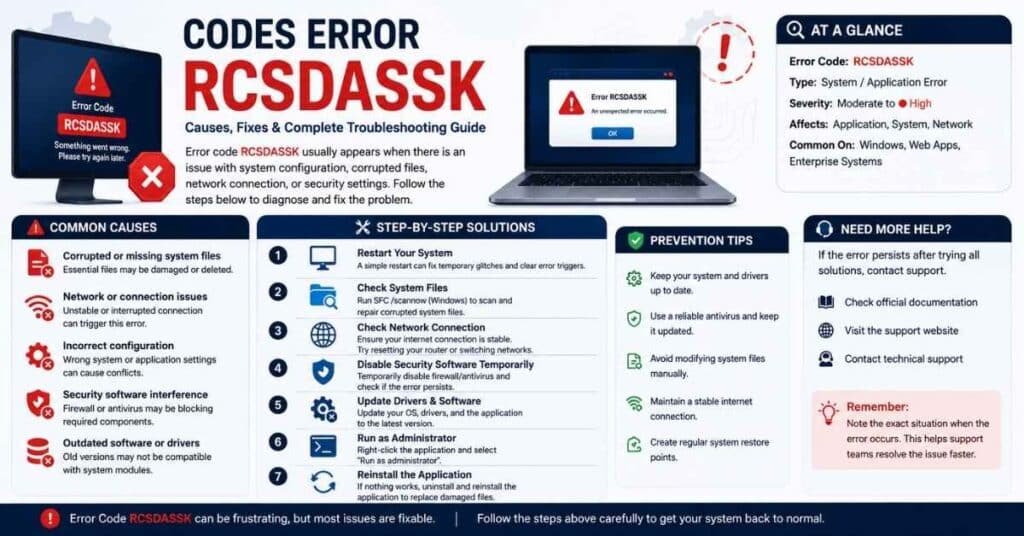
Codes error RCSDASSK is a system or application error that typically points to an underlying issue such as corrupted system files, driver conflicts, software incompatibility, or Windows configuration problems. Although there is no comprehensive official documentation explaining this specific error code, it can usually be resolved by identifying the root cause and applying the correct troubleshooting steps. If you’re seeing this error on Microsoft Windows, don’t panic. In most cases, you can fix it without reinstalling the operating system or losing your personal files.
This guide explains what codes error RCSDASSK means, why it appears, how to diagnose the actual problem, and the safest methods to fix it. Whether you’re a beginner or an advanced user, you’ll find practical solutions supported by standard Windows troubleshooting tools such as System File Checker (SFC), DISM, Event Viewer, Device Manager, and Windows Recovery Environment.
What Is Codes Error RCSDASSK? (Quick Answer)
Codes error RCSDASSK is generally associated with a software, system, or configuration issue that prevents Windows or a specific application from working correctly. The exact meaning can vary depending on the program or environment where the error appears, which is why diagnosing the underlying cause is more important than focusing solely on the error code itself.
What the Error Means
Rather than representing a single problem, codes error RCSDASSK often serves as an indicator that something within your system isn’t functioning as expected. Common causes include:
- Corrupted system files
- Outdated or incompatible drivers
- Software conflicts
- Windows Update issues
- Storage or disk errors
- Incorrect system settings
- Malware interference
The good news is that these problems can often be resolved using built-in Windows repair tools.
Is RCSDASSK Dangerous?
Not necessarily.
In most situations, the error itself does not indicate permanent hardware damage. However, ignoring repeated error messages may allow the underlying issue to worsen over time. If the error appears frequently alongside crashes, slow performance, or startup failures, it’s worth investigating promptly.
Can You Fix It Yourself?
Yes. Most users can resolve codes error RCSDASSK by following a structured troubleshooting process, starting with simple solutions before moving to advanced diagnostics.
Why Does Codes Error RCSDASSK Appear?
Understanding the root cause helps you apply the correct solution instead of trying random fixes.
Corrupted System Files
Windows relies on thousands of protected system files. If any of these files become damaged due to an interrupted update, unexpected shutdown, or software problem, the operating system may generate errors like codes error RCSDASSK.
Running System File Checker (SFC) is often one of the first recommended diagnostic steps.
Outdated or Faulty Drivers
Drivers allow Windows to communicate with hardware such as graphics cards, storage devices, printers, and network adapters.
A corrupted or outdated driver can create conflicts that result in application failures or unexpected system errors.
Updating drivers through Device Manager or your hardware manufacturer’s website may resolve the issue.
Software Conflicts
Installing multiple programs that interact with the same system components can sometimes lead to compatibility issues.
For example:
- Security software
- System optimization tools
- Older applications
- Recently installed utilities
may interfere with Windows processes and trigger unexpected errors.
Windows Update Problems
Occasionally, incomplete or unsuccessful Windows Update installations leave system components in an inconsistent state.
If the error started immediately after updating Windows, repairing the system image or uninstalling the problematic update may help.
Disk or Storage Errors
Bad sectors on an SSD or HDD can corrupt important files used by Windows.
Signs include:
- Slow startup
- Missing files
- Frequent crashes
- Read/write errors
Checking disk health is an important step if the problem continues.
Malware or Security Software Interference
Malicious software may modify Windows files or registry settings, while overly aggressive antivirus programs can occasionally block legitimate system operations.
Running a trusted malware scan helps rule out security-related causes.
Incorrect System Configuration
Changes made to startup services, registry settings, or Windows configuration files may prevent applications from loading correctly.
If you’ve recently modified system settings, consider reversing those changes or using System Restore.
Recognize the Symptoms Before Choosing a Fix
Different symptoms often point toward different causes.
Common Signs of RCSDASSK
You may notice:
- Frequent application crashes
- Windows freezing
- Startup errors
- Unexpected shutdowns
- Slow performance
- Error pop-ups
- Failed software installations
When the Error Usually Appears
Users commonly encounter the error:
- During Windows startup
- While launching an application
- After installing software
- Following a Windows update
- During gaming
- When opening specific files
Identifying when the error appears provides valuable clues.
Symptoms That May Indicate Hardware Failure
If the error is accompanied by:
- Clicking hard drives
- Blue Screen of Death (BSOD)
- Random restarts
- Memory errors
- File corruption
the issue may extend beyond software and require hardware diagnostics.
Symptoms vs. Likely Cause
| Symptom | Likely Cause | Recommended First Fix |
|---|---|---|
| Error after Windows Update | Corrupted system files | Run SFC and DISM |
| Error during startup | Startup conflict | Perform a Clean Boot |
| Error after installing software | Software incompatibility | Remove or reinstall the application |
| Random crashes | Driver or hardware issue | Update drivers and check hardware health |
| Slow performance with errors | Disk problems | Run CHKDSK and inspect drive health |
Diagnose the Problem Before You Start Troubleshooting
Jumping straight into advanced fixes can waste time. A proper diagnosis often reveals the most effective solution.
Check Recent System Changes
Ask yourself:
- Did you install new software?
- Did Windows update recently?
- Did you replace any hardware?
- Did you install new drivers?
Recent changes frequently explain new errors.
Review Event Viewer Logs
Event Viewer records system warnings and application failures.
Look for:
- Critical errors
- Application crashes
- Driver failures
- Disk warnings
- Startup problems
The timestamps often help identify what triggered the issue.
Identify Software Triggering the Error
If codes error RCSDASSK appears only while using one application, the problem is more likely related to that software than to Windows itself.
Try:
- Updating the application
- Repairing the installation
- Reinstalling the program
- Checking for compatibility updates
Determine Whether the Issue Is Software or Hardware Related
A few simple questions can narrow the diagnosis:
- Does the error occur in Safe Mode?
- Does it affect every program or only one?
- Has your PC become unusually slow?
- Are other Windows functions working normally?
These observations help determine whether you’re dealing with a software conflict, operating system issue, or hardware problem.
Step-by-Step Fixes for Codes Error RCSDASSK
Start with the simplest solutions before moving to advanced repairs.
Restart Your Computer
It sounds basic, but a restart clears temporary memory issues and reloads Windows services. If the error resulted from a temporary glitch, this may resolve it immediately.
Install Pending Windows Updates
Open Settings → Windows Update and install all available updates.
Microsoft frequently releases patches that resolve compatibility problems, security vulnerabilities, and system stability issues.
Update or Roll Back Device Drivers
Open Device Manager and check for warning icons.
Update drivers for:
- Graphics cards
- Network adapters
- Storage controllers
- Chipsets
If the problem began after a recent driver update, rolling back to the previous version may be the better solution.
Run System File Checker (SFC)
Open Command Prompt as an administrator and run:
sfc /scannow
System File Checker (SFC) scans protected Windows files and automatically replaces corrupted versions with healthy copies. This process often resolves issues caused by damaged system files after interrupted updates or unexpected shutdowns.
Repair the Windows Image with DISM
If System File Checker (SFC) reports problems that it cannot repair, the next step is to use Deployment Image Servicing and Management (DISM).
Open Command Prompt as an administrator and run:
DISM /Online /Cleanup-Image /RestoreHealth
DISM checks the Windows system image for corruption and downloads clean files from Windows Update when necessary. Once the scan finishes, restart your computer and run SFC again. Using DISM first followed by SFC often repairs system corruption more effectively than running SFC alone.
Perform a Clean Boot
A Clean Boot starts Windows with only essential Microsoft services.
This helps determine whether a third-party application or startup service is causing codes error RCSDASSK.
If the error disappears during a Clean Boot, re-enable startup services one at a time until you identify the conflicting software.
Check Your Hard Drive for Errors
Storage problems can damage important Windows files.
Open Command Prompt and run:
chkdsk /f /r
This command scans your drive for file system errors and bad sectors. If Windows asks to schedule the scan during the next restart, type Y and reboot your computer.
Scan for Malware
Some malware modifies system files, changes registry settings, or interferes with Windows processes.
Run a full scan using Microsoft Defender or another trusted antivirus solution. If malware is detected, remove it and restart your system before checking whether the error still appears.
Restore Your System to an Earlier Point
If codes error RCSDASSK started after installing software, updating drivers, or changing system settings, System Restore may return Windows to a stable state without affecting your personal files.
Choose a restore point created before the problem began.
Reinstall the Affected Program
If the error only occurs when opening one application, the installation may be damaged.
Try these steps:
- Uninstall the application.
- Restart your computer.
- Download the latest version from the official website.
- Install it again.
This often resolves problems caused by missing or corrupted application files.
Reset Windows (Only If Necessary)
If every troubleshooting method fails and Windows continues to display codes error RCSDASSK, resetting the operating system may be your final option.
Choose “Keep my files” whenever possible to preserve personal documents while reinstalling Windows system files.
Advanced Troubleshooting for Persistent RCSDASSK Errors
If the problem continues after completing the basic fixes, investigate potential hardware or deeper system issues.
Test Your RAM
Faulty memory can produce unpredictable system errors.
Run Windows Memory Diagnostic or another trusted memory testing tool to check for defective RAM modules.
Check SSD or HDD Health
Modern storage drives record their health through SMART data.
Use your SSD manufacturer’s utility or another reliable diagnostic tool to review:
- Drive health
- Temperature
- Read/write errors
- Remaining lifespan
If the drive reports serious errors, back up your important files immediately.
Review Startup Services
Too many startup applications can create software conflicts.
Open Task Manager and review startup programs. Disable unnecessary items temporarily to see whether the error disappears.
Inspect BIOS or UEFI Settings
Although uncommon, incorrect BIOS or UEFI settings may contribute to system instability after hardware upgrades or firmware changes.
Only modify BIOS settings if you fully understand their purpose. Otherwise, leave them at their default values.
Analyze Windows Crash Logs
If Windows crashes frequently, reviewing Event Viewer or Reliability Monitor can reveal useful diagnostic information.
Instead of guessing, these logs often point toward:
- Driver failures
- Application crashes
- Disk problems
- Service failures
- Windows component errors
Why Each Fix Works
Understanding why each repair method works helps you choose the most effective solution.
How SFC Repairs System Files
System File Checker (SFC) compares protected Windows files against trusted copies stored by the operating system.
If corruption is detected, SFC automatically replaces damaged files with healthy versions.
What DISM Actually Does
Unlike SFC, DISM repairs the Windows component store itself.
If the operating system’s repair files become damaged, SFC alone may not succeed. DISM restores those components first, allowing SFC to complete its job successfully.
Why Driver Updates Solve Many Errors
Drivers act as communication bridges between Windows and your hardware.
An outdated or incompatible driver may cause:
- Application crashes
- Startup failures
- Hardware instability
- Unexpected error messages
Keeping drivers updated reduces compatibility problems.
How Clean Boot Identifies Software Conflicts
A Clean Boot disables non-essential startup programs.
If the error disappears afterward, you’ve confirmed that another application—not Windows itself—is causing the conflict.
LEARN MORE: Zupfadtazak
Common Mistakes to Avoid
Avoiding these mistakes can save hours of unnecessary troubleshooting.
Downloading Unverified Repair Tools
Many websites promote one-click repair utilities.
Only download software from trusted sources. Unknown repair tools can introduce additional problems or security risks.
Editing the Registry Without a Backup
The Windows Registry controls important operating system settings.
Editing registry entries without understanding their purpose may make Windows unstable. Always create a backup before making changes.
Ignoring Warning Signs
Repeated crashes, unusual noises from storage drives, or frequent file corruption should never be ignored.
Addressing these symptoms early may prevent more serious hardware failures.
Reinstalling Windows Too Early
Many users reinstall Windows before completing basic diagnostics.
In reality, tools like SFC, DISM, CHKDSK, and System Restore often solve the problem without requiring a full operating system reset.
Prevent Codes Error RCSDASSK from Returning
Preventive maintenance is often easier than troubleshooting recurring issues.
Keep Windows Updated
Install security patches and feature updates regularly to improve stability and compatibility.
Maintain Healthy Storage Drives
Monitor SSD and HDD health, remove unnecessary files, and ensure enough free disk space remains available.
Monitor Driver Updates Carefully
Only install drivers from trusted manufacturers and avoid unofficial driver packages.
Create Regular Restore Points
System Restore provides a quick recovery option if software changes create unexpected problems.
Back Up Important Files
Maintain regular backups using cloud storage or an external drive. Even if hardware fails unexpectedly, your personal files remain protected.
Codes Error RCSDASSK vs Similar Windows Errors
| Error Type | Common Cause | Recommended First Step |
|---|---|---|
| Codes Error RCSDASSK | System, software, or configuration issue | Run SFC and review Event Viewer |
| DLL Errors | Missing or corrupted DLL files | Reinstall affected software |
| Startup Errors | Corrupted boot configuration | Use Startup Repair |
| Driver Errors | Outdated or incompatible drivers | Update or roll back drivers |
| Disk Errors | File system corruption or bad sectors | Run CHKDSK |
Understanding the difference helps avoid applying the wrong troubleshooting method.
When Should You Seek Professional Help?
Although most users can fix codes error RCSDASSK, professional assistance may be necessary if:
- Your computer displays repeated Blue Screen errors.
- Hardware diagnostic tests report failures.
- Windows no longer boots.
- Your SSD or HDD reports serious SMART errors.
- System files continue becoming corrupted after repairs.
These symptoms may indicate hardware failure rather than a simple software problem.
Frequently Asked Questions
What is codes error RCSDASSK?
Codes error RCSDASSK generally indicates a system, software, or configuration problem that requires troubleshooting. Common causes include corrupted Windows files, driver conflicts, software incompatibility, or storage issues.
Is codes error RCSDASSK a Windows error?
It is most commonly encountered while using Microsoft Windows, although the exact source depends on the application or system environment where it appears.
Can corrupted system files cause RCSDASSK?
Yes. Damaged or missing Windows system files are among the most common causes. Running SFC and DISM can often repair them.
Does Windows Update trigger this error?
Sometimes. Interrupted or incomplete updates may leave Windows files in an inconsistent state, resulting in system errors.
Is RCSDASSK related to malware?
Malware can interfere with system files and registry settings, making it one of several possible causes. A full security scan is recommended if you suspect an infection.
Can faulty RAM or an SSD cause the error?
Yes. Defective memory modules or failing storage drives may produce repeated system instability and unexpected error messages.
Should I use SFC or DISM first?
Start with SFC. If SFC cannot repair all detected problems, run DISM, restart your computer, and then run SFC again.
Is reinstalling Windows necessary?
Usually not. Most users can resolve codes error RCSDASSK through systematic troubleshooting without reinstalling the operating system.
How can I prevent the error from returning?
Keep Windows updated, maintain healthy storage drives, install trusted drivers, perform regular malware scans, and create restore points before making major system changes.
Final Thoughts
Codes error RCSDASSK may seem confusing at first, but it is often a symptom of an underlying issue rather than a problem that cannot be fixed. In many cases, the solution involves identifying the root cause instead of trying random repairs.
Begin with simple troubleshooting methods such as Windows Update, System File Checker (SFC), DISM, and driver updates. If the problem persists, move on to advanced diagnostics using Event Viewer, Windows Memory Diagnostic, CHKDSK, and hardware health checks.
By following a logical troubleshooting process and understanding why each fix works, you can resolve most codes error RCSDASSK issues safely while reducing the chances of the error returning in the future.
