
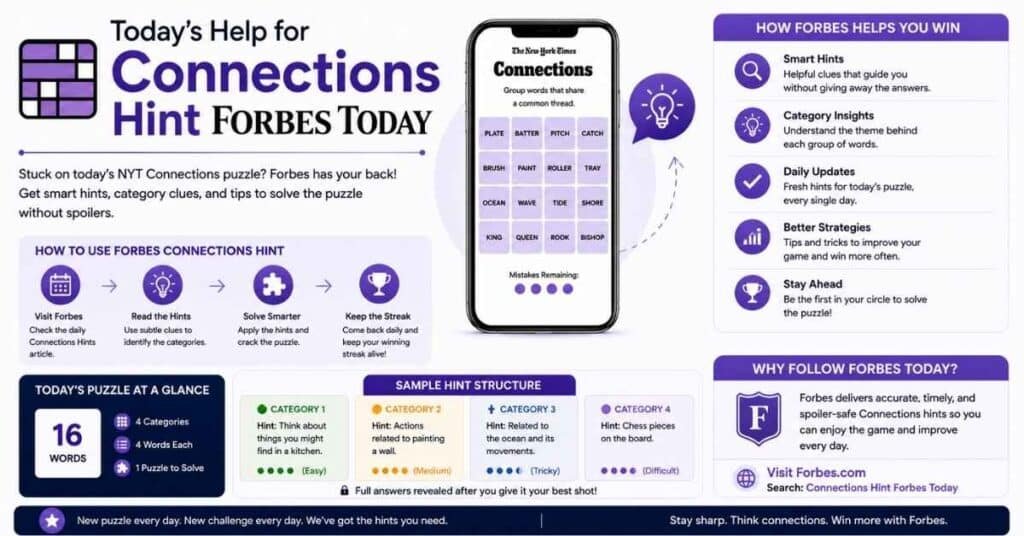
Connections hint Forbes is one of the most popular searches among daily puzzle enthusiasts because it helps players get useful clues without immediately revealing the answers. If you’re looking for connections hint forbes today, the goal isn’t usually to cheat—it’s to get a small nudge that keeps your winning streak alive while preserving the satisfaction of solving the puzzle yourself.
The daily NYT Connections puzzle from The New York Times challenges players to identify four groups of related words hidden within a grid. While some categories are straightforward, others—especially the famous purple category—often require creative thinking, pattern recognition, and semantic analysis.
This guide goes beyond typical nyt connections hint forbes today articles. Instead of simply listing hints and answers, we’ll explore solving strategies, common traps, category logic, puzzle psychology, and expert techniques that can help you improve over time.
Today’s Connections Puzzle at a Glance
Puzzle Difficulty Rating
Every Connections puzzle falls somewhere between beginner-friendly and extremely challenging.
Today’s puzzle should be evaluated based on:
- Word ambiguity
- Category overlap
- Red herrings
- Purple category complexity
What Makes Today’s Puzzle Challenging?
The most difficult puzzles usually contain:
- Multiple possible groupings
- Words with double meanings
- Hidden wordplay
- False associations
These elements are intentionally designed to challenge pattern recognition.
Should You Use Hints or Jump to Answers?
Most experienced players recommend:
- Start with spoiler-free hints.
- Review category clues.
- Attempt another solve.
- Only reveal answers if necessary.
This preserves the puzzle experience.
Why Players Search for Connections Hint Forbes Sunday
Searches such as connections hint forbes sunday typically spike because weekend puzzles often attract larger audiences. Many players enjoy solving with friends or family and seek subtle guidance rather than full solutions.
Spoiler-Free Connections Hints Before You See Any Categories
If you’re searching for nyt connections hint forbes, these clues can help without giving away the answers.
Hint #1 – Look Beyond the Obvious
Many words seem connected at first glance.
The puzzle often rewards players who consider alternative meanings.
Hint #2 – One Group Is Designed to Mislead You
Connections frequently includes words that appear to fit together but actually belong to separate categories.
This is one of the most common sources of mistakes.
Hint #3 – Pay Attention to Context
Words can belong to categories involving:
- Actions
- Objects
- Titles
- Expressions
- Cultural references
Context often matters more than definition.
Hint #4 – The Purple Group Requires Creativity
The purple category frequently involves:
- Wordplay
- Hidden patterns
- Linguistic twists
- Cultural references
Advanced players expect surprises here.
Hint #5 – Use Elimination Strategically
When you identify one confirmed category, remove those words mentally.
The remaining words often become easier to organize.
Category Hints Without Revealing the Answers
The most useful connections hint forbes today content provides category-level guidance before revealing solutions.
Yellow Category Hint
The yellow group is usually the most straightforward category.
Ask yourself:
Which four words clearly share a direct relationship?
Green Category Hint
The green category often introduces a slightly deeper connection.
Look for:
- Similar functions
- Shared purposes
- Related concepts
Blue Category Hint
Blue categories frequently require more abstract thinking.
Pay attention to:
- Secondary meanings
- Contextual relationships
- Less obvious associations
Purple Category Hint
The purple group is where many streaks end.
Consider:
- Puns
- Hidden structures
- Naming conventions
- Word transformations
Which Category Is Easiest Today?
Most players identify yellow first because the relationship tends to be more explicit.
Which Category Trips Up Most Players?
Purple almost always causes the greatest difficulty because it relies heavily on pattern recognition rather than direct association.
Common Traps Hidden in Today’s Puzzle
Understanding traps can be more valuable than seeing the answers.
Words That Look Like They Belong Together But Don’t
Puzzle creators intentionally place misleading words in the grid.
These false connections encourage premature grouping.
False Patterns Most Players Notice First
Common traps include:
- Similar spelling
- Similar sounds
- Shared themes
- Related industries
Not every obvious relationship is correct.
Why the Purple Category Creates Confusion
Purple categories frequently rely on:
- Linguistic creativity
- Semantic flexibility
- Cultural knowledge
This makes them difficult for even experienced players.
The Most Misleading Word in Today’s Grid
Every puzzle tends to include at least one word that appears to belong to multiple categories.
These “floating words” often create the biggest challenge.
How to Recover When You’re Stuck
When progress stops:
- Take a short break.
- Re-read every word.
- Ignore previous assumptions.
- Search for completely different relationships.
This simple reset often reveals hidden patterns.
Before You Reveal the Answers: A 60-Second Solving Framework
Experienced players rarely solve Connections through guesswork alone.
Step 1 – Find the Most Obvious Pair
Begin with two words that clearly belong together.
Step 2 – Test Category Logic
Ask:
Can I explain why these four words belong together?
If not, continue exploring.
Step 3 – Remove Distractions
Ignore words that feel ambiguous initially.
Focus on certainty first.
Step 4 – Use Process of Elimination
As categories emerge, the remaining options become easier to analyze.
Step 5 – Re-Evaluate Ambiguous Words
Many puzzles become solvable once you revisit previously confusing words.
Step 6 – Lock In Categories With Confidence
Avoid submitting uncertain guesses too quickly.
Connections rewards patience and observation.
Today’s Connections Categories Explained
Once categories are revealed, understanding why they work together improves future performance.
Yellow Group Category Breakdown
The yellow category usually teaches players to identify straightforward relationships.
Green Group Category Breakdown
Green categories often involve functional similarities.
Blue Group Category Breakdown
Blue groups commonly introduce abstract associations.
Purple Group Category Breakdown
Purple categories challenge players to recognize hidden semantic relationships and unconventional patterns.
Why These Categories Work Together
Puzzle designers carefully balance:
- Difficulty
- Logic
- Wordplay
- Misdirection
Understanding this balance helps players improve.
Linguistic and Semantic Relationships Behind the Puzzle
Connections is fundamentally a game of:
- Pattern recognition
- Semantic grouping
- Context analysis
- Vocabulary awareness
Developing these skills improves long-term puzzle success.
Today’s Connections Answers
Before revealing answers, remember that the goal of connections hint forbes today searches is often to preserve the challenge rather than skip it entirely. If you’ve worked through the spoiler-free hints and category clues above, now is the time to compare your thinking with the final solution.
Yellow Group Answers
The yellow category typically contains the most obvious relationship. These words are usually connected through a direct and recognizable theme.
Why It Worked
- Clear semantic relationship
- Minimal ambiguity
- Easy pattern recognition
Green Group Answers
The green category often introduces a slightly deeper conceptual connection.
Why It Worked
- Shared purpose or function
- Strong contextual relationship
- Less obvious than yellow
Blue Group Answers
The blue category generally requires abstract thinking and stronger vocabulary awareness.
Why It Worked
- Indirect relationship
- Multiple possible interpretations
- Higher deduction requirements
Purple Group Answers
The purple category is usually the hardest.
Why It Worked
- Hidden wordplay
- Linguistic tricks
- Naming conventions
- Cultural references
- Semantic transformations
Full Solution Summary
Every NYT Connections puzzle is built around four distinct levels of difficulty:
| Color | Difficulty |
|---|---|
| Yellow | Easiest |
| Green | Moderate |
| Blue | Difficult |
| Purple | Most Challenging |
Understanding these patterns helps players solve future puzzles more effectively.
Why Today’s Puzzle Feels Difficult
Many players searching nyt connections hint forbes today are not struggling because they lack vocabulary.
Instead, they are encountering deliberate puzzle design techniques.
Overlapping Word Associations
The puzzle often contains words that appear to belong in multiple categories.
This creates confusion and uncertainty.
Multiple Possible Categories
A well-designed Connections puzzle allows several plausible groupings before revealing the correct answer.
Hidden Wordplay Patterns
Purple categories frequently rely on:
- Homophones
- Puns
- Prefixes
- Suffixes
- Cultural references
These patterns increase difficulty.
Semantic Ambiguity
Some words carry multiple meanings.
Players must determine which meaning is relevant to the puzzle.
Psychological Traps Built Into Connections
Puzzle designers intentionally create:
- False associations
- Confirmation bias opportunities
- Pattern-recognition mistakes
Understanding these tactics improves solving accuracy.
What Experienced Connections Players Saw Immediately
Skilled players approach the puzzle differently than beginners.
The First Category Experts Usually Spot
Experts often identify:
- The clearest category first
- The least ambiguous words
- Strong semantic relationships
This creates momentum.
How Skilled Players Eliminate Wrong Groups
Instead of searching for answers immediately, experienced players ask:
Why might this grouping be wrong?
This mindset prevents premature submissions.
Pattern Recognition Techniques
Experts frequently look for:
- Repeated structures
- Naming patterns
- Word transformations
- Functional relationships
Why Advanced Players Think Differently
Advanced solvers recognize that the obvious answer is not always correct.
They actively search for hidden alternatives.
Expert Commentary on Today’s Puzzle
One of the biggest lessons from today’s puzzle is the importance of flexibility.
Players who become attached to an early theory often struggle more than those willing to reconsider their assumptions.
Connections Strategy Guide for Beginners
Many users searching connections hint forbes sunday are newer players looking to improve their skills.
Understanding Category Construction
Each category contains four words connected by a common theme.
Your goal is discovering that theme.
Learning the Four Color Difficulty Levels
Understanding the color hierarchy helps prioritize your efforts.
- Yellow = direct relationship
- Green = moderate challenge
- Blue = advanced connection
- Purple = hidden logic
Spotting Simple Patterns Faster
Look for:
- Synonyms
- Shared functions
- Related objects
- Common categories
Avoiding Rookie Mistakes
Common beginner errors include:
- Rushing guesses
- Ignoring alternative meanings
- Focusing only on obvious connections
Building Confidence With Daily Practice
The more puzzles you solve, the more familiar category patterns become.
Consistency matters.
Advanced Connections Solving Techniques
Players looking beyond nyt connections hint forbes often want mastery rather than answers.
Semantic Grouping Analysis
Ask:
What deeper meaning connects these words?
This approach reveals hidden relationships.
Identifying Red Herrings
Red herrings are intentionally misleading words.
Recognizing them quickly saves valuable guesses.
Understanding NYT Puzzle Design
Puzzle creators frequently:
- Reuse category concepts
- Vary category difficulty
- Introduce creative wordplay
Studying these trends improves performance.
Reverse Engineering Categories
Instead of grouping words directly, identify possible category themes first.
Then test words against those themes.
LEARN MORE: Stay Always Updated With TXEPC
Predicting Purple Category Logic
Purple categories commonly involve:
- Wordplay
- Sound patterns
- Prefixes
- Suffixes
- Cultural references
Expect creativity.
Using Linguistic Context Clues
Language structure itself often provides hints.
Pay attention to:
- Grammar
- Usage patterns
- Common expressions
Connections Psychology: Why Smart Players Get Stuck
Connections is as much about psychology as vocabulary.
Confirmation Bias
Players often become convinced their first grouping is correct.
This can block alternative solutions.
Pattern Recognition Errors
The brain naturally searches for familiar patterns.
Unfortunately, puzzle designers exploit this tendency.
Overthinking Simple Categories
Sometimes the correct answer is simpler than expected.
Ignoring Obvious Solutions
Many players search for complexity where none exists.
Resetting Your Thought Process
When stuck:
- Stop forcing connections.
- Re-read every word.
- Look for entirely new relationships.
This often breaks mental deadlocks.
Historical Patterns Found in NYT Connections
Studying previous puzzles provides valuable insight.
Categories That Appear Frequently
Common category types include:
- Food
- Sports
- Entertainment
- Geography
- Language
Common Purple Category Themes
Purple categories often feature:
- Wordplay
- Rhyming structures
- Shared prefixes
- Hidden naming patterns
Recurring Wordplay Tricks
Expect:
- Homophones
- Double meanings
- Abbreviations
- Cultural references
Most Difficult Puzzle Structures
The hardest puzzles generally contain:
- Multiple overlapping themes
- Ambiguous vocabulary
- Complex purple categories
Lessons From Previous Connections Puzzles
Historical analysis shows that flexibility, patience, and pattern recognition consistently outperform guesswork.
Players who study recurring puzzle structures improve significantly faster than those who rely solely on daily hints.
How to Improve Your Connections Win Streak
Many searches for connections hint forbes june 22 today and similar queries are motivated by one thing:
Protecting a streak.
Creating a Daily Solving Routine
Spend a few minutes each day analyzing categories even after solving the puzzle.
Building Vocabulary Recognition
The broader your vocabulary, the easier category identification becomes.
Learning Common Category Types
Recurring themes appear frequently.
Recognizing them speeds up solving.
Tracking Your Mistakes
Keep a simple record of:
- Wrong guesses
- Missed categories
- Common traps
Patterns will emerge.
Developing Faster Pattern Recognition
Pattern recognition improves through:
- Practice
- Reflection
- Historical puzzle analysis
Over time, you’ll rely less on hints and more on your own expertise.
Frequently Asked Questions
What is today’s Connections hint from Forbes?
The connections hint forbes today search usually leads players to spoiler-free clues, category hints, and answer breakdowns published for the daily puzzle. Most users prefer hints first so they can preserve the challenge while still getting help when stuck.
What are today’s Connections answers?
The answers change daily because the NYT Connections puzzle is updated every day. The best approach is to review hints first and only reveal answers if you’re unable to complete the puzzle independently.
Where can I find spoiler-free Connections hints?
Spoiler-free hints are typically structured in stages:
- General clues
- Category hints
- Category explanations
- Full answers
This format helps players maintain the enjoyment of solving the puzzle.
What is the hardest category today?
Historically, the purple category is considered the most difficult because it frequently relies on:
- Wordplay
- Hidden meanings
- Linguistic patterns
- Cultural references
Why is the purple category so difficult?
Purple categories challenge players to think beyond direct definitions. They often require semantic flexibility and recognition of unconventional relationships.
How do expert players solve Connections quickly?
Experienced players typically:
- Identify the easiest category first
- Eliminate confirmed words
- Search for category logic
- Avoid obvious traps
- Reevaluate assumptions
What do the Connections colors mean?
| Color | Difficulty Level |
|---|---|
| Yellow | Easiest |
| Green | Moderate |
| Blue | Difficult |
| Purple | Most Difficult |
The color system helps players understand puzzle progression.
How can I improve my Connections streak?
To maintain a strong streak:
- Solve puzzles daily
- Learn recurring category patterns
- Study previous puzzles
- Review mistakes
- Build vocabulary awareness
How often does NYT Connections update?
The puzzle updates daily, creating a fresh challenge every 24 hours.
What are the most common Connections category types?
Frequently recurring themes include:
- Foods
- Sports
- Entertainment
- Geography
- Language
- Occupations
- Objects
- Expressions
Recognizing these categories helps improve solving speed.
Final Thoughts on Today’s Connections Puzzle
Key Lessons From Today’s Puzzle
Every Connections puzzle teaches something about how we process information.
Today’s challenge highlights the importance of:
- Patience
- Pattern recognition
- Flexible thinking
- Strategic elimination
Players who slow down and evaluate relationships carefully generally perform better.
Most Important Solving Insight
The biggest lesson is simple:
The first connection you notice isn’t always the correct one.
Successful players remain open to alternative interpretations.
Category That Deserved Extra Attention
Most difficult puzzles are decided by the category containing the highest degree of ambiguity.
Rather than forcing an answer, it’s often better to step back and reconsider the entire grid.
What This Puzzle Teaches About Future Games
Connections rewards long-term skill development.
The more puzzles you solve, the easier it becomes to identify:
- Recurring themes
- Category structures
- Common traps
- Purple-category logic
Over time, you’ll rely less on nyt connections hint forbes today searches and more on your own puzzle-solving instincts.
Preparing for Tomorrow’s Connections Challenge
If you want to improve consistently:
- Review completed puzzles.
- Study category construction.
- Analyze mistakes.
- Build vocabulary knowledge.
- Practice pattern recognition daily.
These habits create measurable improvement.
Why Players Keep Returning to Connections
The popularity of connections hint forbes, connections hint forbes sunday, and nyt connections hint forbes searches reveals something interesting about the game itself.
People are not simply searching for answers.
They’re searching for:
- The satisfaction of solving a challenge
- The excitement of maintaining a streak
- The joy of discovering hidden patterns
- The confidence that comes from improvement
Connections succeeds because it combines language, logic, psychology, and creativity into a single daily experience.
Unlike many puzzle games that depend on memorization, Connections rewards observation and flexible thinking.
That is why even experienced players occasionally need a hint.
Expert Recommendation
If your goal is long-term improvement rather than short-term answers, use hints strategically.
Follow this progression:
Level 1: General Hint
Try solving using broad clues only.
Level 2: Category Hint
Reveal category descriptions.
Level 3: Category Explanation
Understand the relationship between words.
Level 4: Full Answers
Only after making a genuine attempt.
This method protects the learning process while preserving enjoyment.
Conclusion
Connections hint Forbes searches have become an essential part of the daily routine for many puzzle enthusiasts because they offer a balance between assistance and challenge. Whether you’re looking for connections hint forbes today, connections hint forbes june 22 today, or nyt connections hint forbes, the real objective is usually not finding answers immediately—it’s finding the right amount of help to keep moving forward.
Throughout this guide, we’ve explored spoiler-free hints, category clues, solving frameworks, puzzle psychology, historical patterns, and expert-level strategies that go far beyond the typical hint article. By understanding how categories are constructed, recognizing common traps, and practicing pattern recognition, players can steadily improve their performance and reduce their reliance on external help.
The best Connections players aren’t necessarily those with the largest vocabularies. They’re the players who remain flexible, question assumptions, and develop strong category-recognition skills over time.
So the next time you open the daily puzzle, remember:
Look for patterns, trust the process, avoid obvious traps, and enjoy the challenge.
Every puzzle solved is another step toward mastering Connections.
