
Artificial intelligence is no longer limited to research labs or science-fiction movies. Today, AI helps businesses write code, analyze data, automate customer support, detect fraud, develop new medicines, and improve everyday workflows.
The keyword Droven.io best AI startups in USA refers to information and insights about promising American artificial intelligence companies, emerging AI technologies, and the startups shaping the future of business. In simple terms, it helps readers explore how AI startups are building practical tools, solving industry problems, and creating new opportunities across the United States.
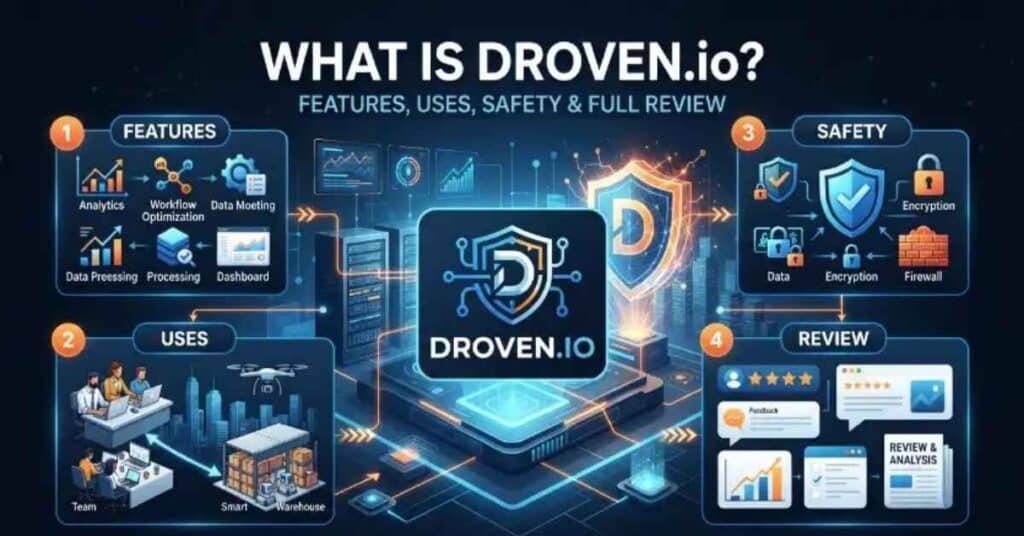
Droven.io presents itself as an editorial platform covering artificial intelligence, emerging technology, software development, digital transformation, innovation, and the future of work. Its content aims to make complex technology topics easier to understand for founders, developers, businesses, and technology enthusiasts.
The United States remains one of the world’s largest AI innovation centers. New companies continue to develop generative AI systems, autonomous agents, enterprise software, healthcare tools, cybersecurity platforms, robotics technology, and machine-learning infrastructure. Major startup directories now track well over a thousand AI companies, showing how quickly the sector has expanded.
This guide explains what makes an AI startup successful, which categories are growing, how to evaluate AI companies, and why the U.S. startup ecosystem continues to influence the global AI market.
What Does Droven.io Best AI Startups in USA Mean?
Droven.io best AI startups in USA is best understood as a technology-focused search topic connected with AI startup research, innovation, software tools, and business growth.
The phrase may lead readers to an article or resource discussing AI companies in the United States. However, “best” does not have one fixed definition.
A startup may stand out because of:
- Strong technology
- Rapid customer growth
- Useful products
- Major funding
- Industry impact
- Skilled leadership
- Research achievements
- Strong business performance
Therefore, the best AI startup for one person may not be the best choice for another.
For example, a healthcare organization may value an AI company that improves clinical workflows. A software developer may prefer a company that builds coding tools. Meanwhile, a small business may focus on affordable AI automation.
The most useful approach is to evaluate startups based on their real-world value rather than popularity alone.
Why the United States Leads AI Startup Innovation
The U.S. has several advantages that support AI entrepreneurship.
Access to Investment
AI development can require significant funding. Companies may need resources for:
- Research
- Computing infrastructure
- Data systems
- Engineering teams
- Product development
- Security
- Customer support
The United States has a large network of venture capital firms, technology investors, startup accelerators, and research organizations.
Private investment in AI continues to support companies working on foundation models, enterprise software, robotics, healthcare technology, and other advanced applications.
Strong Research Institutions
Universities and research centers contribute to AI development through:
- Machine-learning research
- Computer science education
- Robotics programs
- Data science
- AI safety studies
The growing number of AI-focused educational programs also supports the future talent pipeline.
Large Technology Ecosystems
Technology hubs provide access to:
- Skilled engineers
- Startup founders
- Investors
- Researchers
- Enterprise customers
- Business mentors
Important AI startup regions include:
- San Francisco Bay Area
- New York City
- Boston
- Seattle
- Austin
- Los Angeles
However, remote work and cloud technology have also allowed startups to grow outside traditional technology centers.
Strong Demand for AI Solutions
Businesses want AI tools that save time, reduce repetitive work, improve decisions, and support growth.
As a result, startups can develop products for many industries, including:
- Healthcare
- Finance
- Education
- Retail
- Cybersecurity
- Manufacturing
- Marketing
- Software development
Major Categories of AI Startups in the USA
The AI startup ecosystem is broad. Different companies focus on different problems.
Generative AI Startups
Generative AI creates new content from user instructions.
It can generate:
- Text
- Images
- Audio
- Video
- Software code
- Business documents
These tools can support creativity and productivity.
However, users should review AI-generated content because systems may produce errors or inaccurate information.
AI Coding Startups
AI coding platforms help developers:
- Write code
- Explain software
- Find errors
- Generate tests
- Improve documentation
- Automate repetitive programming tasks
These tools can increase productivity. Still, developers must review generated code for security, accuracy, and performance.
Enterprise AI Companies
Enterprise AI platforms help organizations automate internal processes.
Common uses include:
- Customer support
- Document analysis
- Business reporting
- Knowledge management
- Workflow automation
- Data analysis
Businesses often value security, reliability, integration, and administrative controls.
Healthcare AI Startups
Healthcare AI may support:
- Medical research
- Clinical documentation
- Diagnostic assistance
- Drug discovery
- Patient communication
- Administrative automation
The Healthcare applications require careful testing because errors may affect patient care.
Therefore, companies must consider privacy, regulation, safety, and professional oversight.
Cybersecurity AI Startups
Cybersecurity companies use AI to:
- Detect unusual activity
- Identify threats
- Analyze security events
- Automate responses
- Protect digital systems
AI can help security teams process large amounts of information.
However, attackers can also use AI. As a result, cybersecurity remains an ongoing challenge.
Robotics and Physical AI
Robotics startups combine AI with machines that interact with the physical world.
Potential applications include:
- Warehousing
- Manufacturing
- Logistics
- Agriculture
- Home assistance
Physical AI has attracted growing investor attention as companies develop systems that help robots understand and complete real-world tasks.
Examples of Influential AI Startup Categories
Instead of treating one list as a permanent ranking, it is more useful to examine companies by their area of innovation.
Foundation Model Companies
Foundation-model companies develop large AI systems that can support many applications.
Their technology may power:
- Chatbots
- Writing assistants
- Coding tools
- Research systems
- Business automation
These companies often require large computing resources and extensive research.
AI Search and Knowledge Platforms
AI search tools aim to help users find and understand information more efficiently.
They may provide:
- Summaries
- Source-based answers
- Research assistance
- Conversational search
Users should still verify important information because AI summaries can omit context or include mistakes.
AI Developer Tools
Developer-focused startups create tools that help software teams work faster.
These platforms may support:
- Code generation
- Debugging
- Testing
- Documentation
- Deployment
AI coding tools have become an important part of the broader software ecosystem.
Vertical AI Startups
Vertical AI companies focus on one industry.
For example, a company may build AI tools specifically for:
- Lawyers
- Doctors
- Financial analysts
- Teachers
- Manufacturers
Industry specialization can help startups solve problems that general-purpose tools may not address.
What Makes an AI Startup Successful?
A strong AI model does not automatically create a successful business.
Startups also need a clear strategy.
A Real Customer Problem
Successful companies usually solve a specific problem.
For example:
“We use AI to reduce the time required to process business documents.”
This is clearer than:
“We are building the future with AI.”
Customers need to understand the practical benefit.
Reliable Technology
AI systems should perform consistently.
Companies must evaluate:
- Accuracy
- Speed
- Security
- Reliability
- Cost
- Scalability
A product may attract attention during a demonstration but struggle in real-world use.
A Sustainable Business Model
Startups need a way to generate long-term revenue.
Common models include:
- Monthly subscriptions
- Usage-based pricing
- Enterprise contracts
- Software licensing
- Professional services
A popular product may still face challenges if operating costs grow faster than revenue.
Strong Leadership
Startup leaders must manage technology, customers, hiring, investment, and strategy.
A skilled team can adapt when the market changes.
Responsible AI Practices
Responsible AI includes:
- Data protection
- Security
- Transparency
- Human oversight
- Bias testing
- Risk management
Trust can become a competitive advantage.
How AI Startups Help Businesses
AI startups can help companies improve productivity.
Common benefits include:
Automation
AI can handle repetitive tasks such as:
- Sorting documents
- Responding to common questions
- Summarizing information
- Organizing data
This may allow employees to focus on higher-value work.
Faster Decision-Making
AI tools can analyze large amounts of information.
However, businesses should avoid treating automated recommendations as final decisions.
Human review remains important.
Better Customer Support
AI assistants can provide answers outside normal business hours.
Still, customers should be able to reach a human when the issue is complex.
Improved Software Development
AI coding tools may help developers complete routine tasks faster.
Developers must test the results before using them in production systems.
How to Evaluate the Best AI Startups in USA
Before choosing an AI company or product, use a structured evaluation process.
Step 1: Define Your Goal
Ask:
- What problem do I need to solve?
- Which tasks take the most time?
- What result do I expect?
A clear goal makes comparison easier.
Step 2: Review the Product
Check:
- Main features
- Ease of use
- Integrations
- Performance
- Documentation
Do not rely only on marketing claims.
Step 3: Examine Privacy and Security
Review:
- Data collection
- Data storage
- User permissions
- Security controls
- Account management
This is especially important when the tool processes customer or business information.
Step 4: Compare Pricing
Consider:
- Monthly costs
- Usage limits
- Additional fees
- Enterprise pricing
- Long-term expenses
An inexpensive tool may become costly as usage increases.
Step 5: Test the Product
Use a free trial or small pilot project when possible.
Test real tasks instead of only exploring sample demonstrations.
Step 6: Measure Results
Track:
- Time saved
- Accuracy
- Employee adoption
- Customer satisfaction
- Return on investment
If the tool does not solve a meaningful problem, it may not provide enough value.
Benefits of Following AI Startup Trends
Following AI innovation can help people discover:
- New technology tools
- Business opportunities
- Emerging careers
- Investment trends
- Industry changes
- Productivity solutions
However, readers should avoid assuming that every new AI company will succeed.
Startup markets change quickly. Funding, popularity, and media attention do not guarantee long-term performance.
Challenges Facing AI Startups
AI startups also face important obstacles.
High Computing Costs
Advanced AI systems may require expensive computing infrastructure.
Companies must balance performance with cost.
Competition
The AI market includes large technology companies, research labs, and thousands of startups.
A useful product can quickly face new competitors.
Data Privacy
AI systems may process sensitive information.
Companies must protect data and follow applicable laws.
Model Accuracy
AI can produce incorrect or misleading results.
Therefore, high-risk applications need strong testing and human oversight.
Changing Regulations
Governments continue to develop AI rules.
Startups may need to adapt to new requirements involving safety, transparency, privacy, and accountability.
Future Trends for AI Startups in the USA
The AI industry continues to evolve.
Several trends may shape future growth.
AI Agents
AI agents may complete multi-step tasks with less direct supervision.
Potential uses include:
- Research
- Customer support
- Software development
- Business operations
However, companies must monitor agents carefully.
LEARN MORE: News Lovelolablog
Smaller and More Efficient Models
Businesses increasingly want AI systems that provide strong performance at lower costs.
This may increase interest in specialized and efficient models.
Industry-Specific AI
More startups may build tools for specific professions.
These products may provide greater value because they understand industry workflows.
AI and Robotics
AI-powered robots may become more useful in warehouses, factories, and other physical environments.
Human-AI Collaboration
Many successful products may focus on helping people work better rather than replacing them entirely.
Human judgment will remain important in complex decisions.
Frequently Asked Questions
What does Droven.io best AI startups in USA mean?
The phrase refers to content and research related to leading AI startups, emerging artificial intelligence companies, and technology innovation in the United States.
Is Droven.io an AI startup?
Droven.io describes itself as an editorial platform that publishes information about AI, emerging technology, software, digital transformation, and innovation. It should not automatically be treated as a foundation-model company or AI software startup.
What are AI startups?
AI startups are companies that develop products or services using artificial intelligence, machine learning, natural language processing, computer vision, automation, or related technologies.
Which AI startup is the best?
There is no single best AI startup for every user.
The right company depends on the industry, product quality, customer needs, security requirements, and business goals.
Why are AI startups growing quickly?
AI technology can automate work, analyze data, improve software, and create new products.
Growing business demand and investment also support startup growth.
Are AI startups good investment opportunities?
AI startups may offer opportunities, but they also involve significant risk.
Funding, popularity, and technology demonstrations do not guarantee success. Investors should conduct independent research and consider professional financial advice.
How can businesses choose an AI startup?
Businesses should define their needs, test products, review security, compare pricing, evaluate integrations, and measure results.
Conclusion
Droven.io best AI startups in USA highlights the rapid growth of artificial intelligence companies and the technologies reshaping modern business.
The U.S. AI ecosystem includes companies working on generative AI, software development, enterprise automation, healthcare, cybersecurity, robotics, and industry-specific tools.
However, the best AI startup is not always the one with the largest valuation or the most media attention. A strong company solves a real problem, delivers reliable technology, protects user data, and creates measurable value.
If you want to explore the AI startup landscape, begin by identifying your goals. Then compare tools, review official information, test products, and measure real results.
AI will continue to change how people work and build businesses. Therefore, staying informed can help you recognize useful opportunities while avoiding unnecessary hype.
