

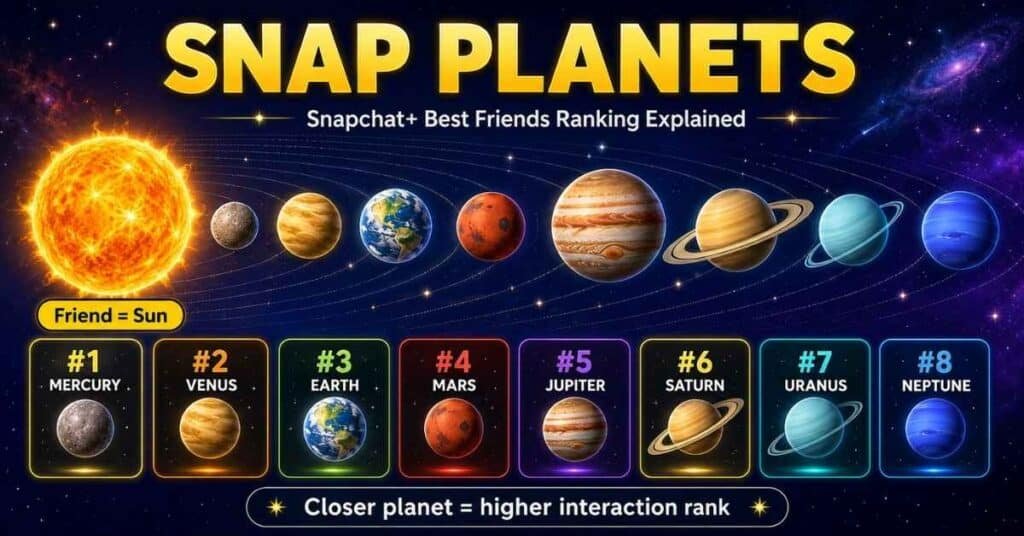
Snap planets can turn a quick profile check into a surprisingly serious question: “Why am I Mars instead of Mercury?” The simple answer is that Snapchat uses eight planets to represent your position in a friend’s Best Friends list. Your friend appears as the Sun, while your Bitmoji appears on Mercury, Venus, Earth, Mars, Jupiter, Saturn, Uranus, or Neptune.
Mercury represents the closest position, while Neptune represents the farthest position within the eight-person system. Therefore, the closer your planet sits to the Sun, the higher your position appears to be in that friend’s Snapchat interactions.
However, a Snapchat planet does not measure loyalty, affection, or the real strength of a friendship. Instead, it reflects how people interact through Snaps and Chats. Snapchat also keeps the feature private, optional, and limited to Snapchat+ subscribers.
What Are Snap Planets?
Snap planets form part of Snapchat’s Friend Solar System, a premium Snapchat+ feature that visually represents Best Friends positions.
In this system:
- Your friend appears as the Sun
- Your Bitmoji appears on a planet
- Each planet represents a different Best Friends position
- Planets closer to the Sun indicate closer Snapchat interaction
- Only the person viewing the Friendship Profile sees their own planet
Snapchat allows users to have up to eight Best Friends. As a result, the Friend Solar System uses the eight recognized planets from Mercury to Neptune. Snapchat updates Best Friends regularly based on the people you Snap and Chat with most.
The feature does not display a public list of everyone in someone’s solar system. It only gives you information about your own position in that friendship.
Snap Planets Order From Closest to Farthest
The Snapchat planet order follows the same sequence as the real solar system:
| Snap Planet | Commonly Understood Position | Meaning |
|---|---|---|
| Mercury | 1st | Closest Snapchat friend |
| Venus | 2nd | Second-closest Snapchat friend |
| Earth | 3rd | Third position |
| Mars | 4th | Fourth position |
| Jupiter | 5th | Fifth position |
| Saturn | 6th | Sixth position |
| Uranus | 7th | Seventh position |
| Neptune | 8th | Eighth position |
Snapchat’s official support guide presents the Friendmoji planets in this order: Mercury, Venus, Earth, Mars, Jupiter, Saturn, Uranus, and Neptune.
Snapchat does not display a large number beside your name. In fact, Snap describes the Solar System as a visual friendship indicator rather than a public numerical leaderboard. Nevertheless, users commonly interpret Mercury through Neptune as positions one through eight because each planet represents a different place in the Best Friends list.
What Do the Snapchat Planets Mean?
Each planet represents a different level of interaction with a friend. Here is a detailed explanation of every Snap planet meaning.
Mercury Meaning on Snapchat
Mercury represents the closest position to the Sun. In practical terms, it generally means you occupy the first position in that friend’s Solar System.
You and that person likely communicate frequently through Snapchat. However, Mercury does not prove that you are their closest friend in real life. It only reflects activity that Snapchat can measure inside the app.
Furthermore, friendship positions may not match in both directions. You could appear as Mercury in someone’s Solar System while that person occupies a different position in yours.
Venus Meaning on Snapchat
Venus represents the second position in the Snap planets order.
If you appear on Venus, one other friend currently sits closer to the Sun. Even so, your position indicates frequent interaction and places you near the top of that person’s Best Friends activity.
Venus can change to Mercury if your interactions increase relative to the friend’s other conversations. On the other hand, it can move farther away when communication decreases.
Earth Meaning on Snapchat
Earth represents the third position in a friend’s Solar System.
Being Earth means you remain one of the person’s most active Snapchat contacts. However, two other friends currently appear closer to the Sun.
Do not interpret Earth as a negative result. A person may have hundreds of contacts, yet Snapchat only places up to eight people in the standard Best Friends group.
Mars Meaning on Snapchat
Mars commonly represents the fourth position in the Snapchat Friend Solar System.
This planet sits around the middle of the eight-position order. Therefore, you interact regularly with the person, although three other contacts currently rank closer based on Snapchat activity.
A Mars position may change when either of you starts sending more Snaps or having more direct conversations. However, Snapchat does not publish the exact calculation behind every movement.
Jupiter Meaning on Snapchat
Jupiter represents the fifth position in the Snap planets sequence.
Although Jupiter appears farther from the Sun, it still places you among a relatively small group of frequently contacted friends. Consequently, it should not automatically cause concern.
You may appear as Jupiter because you communicate through other platforms, speak in person, or interact less frequently on Snapchat than the person’s other friends do.
Saturn Meaning on Snapchat
Saturn represents the sixth position in the Friend Solar System.
Five contacts currently appear closer to the Sun. Still, your presence on Saturn suggests that you maintain enough Snapchat interaction to remain within the displayed Best Friends group.
Saturn’s familiar rings may make it easy to recognize visually. However, Snapchat can update interface designs, animations, and Bitmoji arrangements, so users should identify their position by the planet itself rather than relying only on background colors or decorative icons.
Uranus Meaning on Snapchat
Uranus represents the seventh position in the Snapchat planet order.
You sit close to the outer edge of the Friend Solar System. Therefore, increased activity could move you closer to the Sun, while less interaction could cause your position to change or disappear.
Still, Uranus does not mean that the person dislikes you. The feature tracks app communication, not personal feelings.
Neptune Meaning on Snapchat
Neptune represents the eighth and final position in the standard Snap Solar System.
As the farthest displayed planet from the Sun, Neptune indicates that seven other Best Friends positions appear closer. However, you still remain within the person’s eight-position system.
Neptune often causes unnecessary worry because people assume it means a friendship is ending. In reality, you may simply communicate less frequently on Snapchat than the person’s other contacts.
How Does the Snapchat Friend Solar System Work?
Snapchat determines Best Friends from the people you Snap and Chat with the most. It displays those contacts prominently on the Send To screen and in the Chat section. The platform may update the list regularly as interaction patterns change.
The Friend Solar System then adds a visual layer to this existing system.
When you open an eligible Friendship Profile, Snapchat may display a gold-ringed Best Friends badge. Tapping that badge reveals your Bitmoji on a planet in the other person’s Solar System.
The feature works through several basic signals:
- You exchange Snaps with a person.
- You communicate through direct Chats.
- Snapchat compares that interaction with other friendships.
- The Best Friends list updates over time.
- Your planet may move as communication patterns change.
Snapchat does not publicly reveal the exact weighting formula. Therefore, no outside guide can reliably promise that sending a specific number of Snaps will move you from Neptune to Mercury.
Are Snap Planets a Numerical Ranking?
Snapchat describes Friend Solar Systems as a private visual representation rather than a numerical ranking. The feature does not display a public chart marked “number one” through “number eight.”
However, each planet represents a different position in a person’s Best Friends list. Since the planets appear in their natural order from Mercury to Neptune, users commonly describe them as positions one through eight.
Both statements can be true:
- Snapchat does not show a public numbered leaderboard.
- Each planet still corresponds to a different Best Friends position.
Therefore, calling Mercury “first” and Neptune “eighth” provides a convenient explanation, but the feature should not be treated as an exact measure of friendship quality.
How to Check Your Snapchat Planet
You need a Snapchat+ subscription to use Friend Solar Systems. Snapchat lists Solar System among the exclusive features available through its paid subscription.
Follow these steps:
- Open Snapchat and tap your profile icon.
- Select the Snapchat+ membership card.
- Find the Solar System option.
- Toggle the feature on.
- Return to your Chat screen.
- Open an eligible friend’s Friendship Profile.
- Look for a gold-ringed Best Friends badge.
- Tap the badge to view your planet.
Snapchat turns Solar System off by default for first-time subscribers. As a result, you may need to activate it manually even after purchasing Snapchat+. You can also turn it off again from the feature management page.
Why Can’t I See My Snap Planet?
Several issues can prevent the Solar System from appearing.
You Do Not Have Snapchat+
Friend Solar Systems are part of Snapchat+. Standard Snapchat accounts do not receive access to every premium feature.
Solar System Is Turned Off
The feature may remain disabled after you subscribe. Open the Snapchat+ feature management page and check whether Solar System is active.
The Friendship Profile Has No Eligible Badge
You can only open a Solar System through the relevant badge. If Snapchat does not show the badge, it may not have a planet position available for that profile.
Your App Is Outdated
An older version of Snapchat may not display current features properly. Update the app through your device’s official app store, close it completely, and open it again.
Your Friendship Activity Changed
Best Friends update regularly. Therefore, a planet or badge may change when you communicate more or less with certain people.
Snapchat Is Testing or Adjusting Features
Snapchat+ includes exclusive, experimental, and pre-release features. Availability and presentation may differ by account, device, region, or app version.
What Makes Your Snap Planet Change?
Your planet can change because Snapchat regularly recalculates Best Friends based on communication activity.
Several factors may affect your position:
- How frequently you exchange direct Snaps
- How often you Chat with each other
- How recent your conversations are
- How much the person interacts with other contacts
- Changes in both users’ Snapchat habits
For example, you may continue sending the same number of Snaps while moving from Venus to Earth. That shift could happen because the person started communicating more frequently with somebody else.
Therefore, your planet depends on relative activity, not only your individual effort.
Does a Snapstreak Affect Your Planet?
A Snapstreak and a Snapchat planet are related to communication, but they measure different things.
A Snapstreak counts consecutive days in which two people exchange qualifying Snaps. Meanwhile, the Friend Solar System reflects broader communication frequency within the Best Friends system. Snapchat describes Streaks as a private representation of consecutive Snap exchanges, while Best Friends relate to frequent communication over a rolling period.
As a result, a long Snapstreak may contribute to regular interaction, but it does not guarantee Mercury.
You could maintain a long streak with someone and still appear farther from the Sun if that person communicates more frequently with other contacts.
Do Chats Count Toward Snap Planets?
Yes. Snapchat states that Best Friends are the people you Snap and Chat with the most. Therefore, direct Chats contribute to the activity behind the Best Friends system.
However, Snapchat does not explain how it weighs a Chat against a photo Snap, video Snap, reply, or other action.
For this reason, avoid claims such as:
- One Chat equals a certain number of points
- Video Snaps always count more than photos
- Group messages guarantee a higher position
- A fixed number of daily Snaps unlocks Mercury
Snapchat has not publicly confirmed formulas like these.
Does Snap Score Determine Your Planet?
Your overall Snap Score does not directly tell you which planet you will receive.
Snap Score reflects broader activity on an account. In contrast, Friend Solar Systems focus on the interaction between particular friends.
A user with a very high Snap Score could still appear as Neptune in someone’s system. Similarly, a person with a lower overall score could appear as Mercury if they communicate with that friend more frequently.
Can Snap Planets Be Different for Both Friends?
Yes, friendship positions can differ because each user has their own activity patterns and Best Friends list.
For example:
- You may appear as Mercury in Sam’s system.
- Sam may appear as Mars in your system.
- You could be one of Sam’s most frequent contacts.
- Meanwhile, you may communicate with three other people more often than Sam.
This difference does not automatically signal an unbalanced friendship. It simply reflects how each account uses Snapchat relative to its other contacts.
Snap Planets vs. Friend Emojis
Snap planets and Friend Emojis both provide context about Snapchat relationships, but they work differently.
| Feature | What It Communicates |
|---|---|
| Snap planets | Your position within a friend’s Solar System |
| Yellow heart | You are each other’s number-one Best Friend |
| Red heart | You have remained mutual number-one Best Friends for two weeks |
| Pink hearts | You have remained mutual number-one Best Friends for two months |
| Smiling face | The person is one of your Best Friends |
| Fire emoji | You have an active Snapstreak |
Friend Emojis depend on how you and your friends use Snapchat, and they may change regularly.
Unlike the Solar System feature, Friend Emojis can reveal mutual relationship categories. For example, the yellow heart specifically means that both users send the most Snaps to each other.
Are Snapchat Planets Private?
Yes. Snapchat describes the Solar System as an optional and private feature.
It does not show you the identities of the other people in a friend’s Solar System. It also does not make your planet visible to everyone or publish the person’s full Best Friends list.
You see only the information connected to your own friendship. Consequently, you cannot tap through the planets to discover who occupies Mercury, Venus, or another position.
LEARN MORE: Snapjotz Com
Do Snap Planets Measure Real Friendship?
No. Snap planets measure interaction inside Snapchat, not the emotional value of a relationship.
Your closest real-life friend may appear as Uranus because you mainly speak in person or through another messaging service. Meanwhile, a classmate may appear as Mercury because you exchange several daily Snaps.
Snap has acknowledged that friendship features may make some users feel pressure or disappointment. For that reason, the company made Solar System optional and disabled it by default for first-time subscribers.
Use the feature as a fun piece of social context. Do not use it as evidence that someone values, trusts, or cares about you more or less.
Common Myths About Snap Planets
“Neptune Means the Friendship Is Over”
Neptune only indicates the outermost position in the eight-planet system. It does not reveal how someone feels about you.
“Mercury Means You Are Mutual Best Friends”
Mercury shows a strong position in the Solar System. However, mutual number-one Best Friends are more clearly represented by the yellow heart Friend Emoji.
“Watching Stories Moves You Closer to the Sun”
Snapchat officially links Best Friends with frequent Snaps and Chats. It does not publicly confirm that Story views directly improve your Solar System position.
“A Long Streak Guarantees Mercury”
A streak records consecutive Snap exchanges, while the Solar System reflects broader friendship activity. Therefore, a long streak alone does not guarantee the closest planet.
“You Can Choose Your Planet”
Snapchat assigns the planet automatically. You cannot manually select Mercury, Venus, or another position.
“Everyone Can See Your Ranking”
Friend Solar Systems are private. Other users cannot access a public list showing your position.
Frequently Asked Questions About Snap Planets
What are Snap planets?
Snap planets are part of Snapchat’s Friend Solar System. They place your Bitmoji on one of eight planets to represent your position in a friend’s Best Friends activity.
What is the Snap planets order?
The order is Mercury, Venus, Earth, Mars, Jupiter, Saturn, Uranus, and Neptune. Mercury sits closest to the Sun, while Neptune sits farthest away.
What planet is number one on Snapchat?
Mercury represents the closest or first position in the commonly understood Snapchat planet order.
What does Venus mean on Snapchat?
Venus generally represents the second position in a friend’s Solar System.
What does Earth mean on Snapchat?
Earth represents the third position in the Snap planets sequence.
What does Mars mean on Snapchat?
Mars commonly represents the fourth Best Friends position.
What does Jupiter mean on Snapchat?
Jupiter represents the fifth position in the Snapchat Friend Solar System.
What does Saturn mean on Snapchat?
Saturn represents the sixth position.
What does Uranus mean on Snapchat?
Uranus represents the seventh position and sits near the outer edge of the Solar System.
What does Neptune mean on Snapchat?
Neptune represents the eighth and farthest displayed position. It does not mean the friendship is bad or ending.
Is Mercury better than Venus on Snapchat?
Mercury represents a closer position than Venus based on Snapchat activity. However, it does not prove that one friendship is emotionally stronger than another.
Can you see other people in a friend’s Solar System?
No. The feature shows your own position and does not reveal the identities of the person’s other Best Friends.
Can someone see what planet they are in my Solar System?
An eligible Snapchat+ user may view the planet connected to their own friendship. However, they cannot view your complete Best Friends list.
Can you change your Snapchat planet?
You cannot change it manually. Your position may change naturally when Snap and Chat activity changes.
Why did I move from Mercury to Venus?
Another user may have started communicating more frequently with that friend, or your recent interaction may have decreased. Best Friends update regularly.
Why did my Snap planet disappear?
You may no longer have an eligible badge, the feature may be disabled, your Best Friends activity may have changed, or Snapchat may be adjusting feature availability.
Are Snap planets available without Snapchat+?
No. Snapchat currently lists Solar System as a Snapchat+ feature.
Why is Pluto not included?
Snapchat uses eight planets because its standard Best Friends system contains up to eight friends. Pluto is classified as a dwarf planet and does not appear in the eight-planet sequence.
Conclusion
Snap planets offer a visual way to understand your position within a friend’s Snapchat interactions. Mercury represents the closest position, followed by Venus, Earth, Mars, Jupiter, Saturn, Uranus, and Neptune.
However, the planets reflect app activity rather than real-world affection. They can change as people send Snaps, exchange Chats, and communicate with other contacts. Furthermore, Snapchat keeps the feature private, optional, and exclusive to Snapchat+.
Therefore, enjoy the Friend Solar System as a fun Snapchat feature, but avoid letting one planet define an important relationship. Next, explore related guides about Snapchat Friend Emojis, Best Friends lists, Snapstreaks, Snap Scores, and Snapchat+ features to understand how the platform’s friendship indicators work together.
